“If growth is no better than BKNG’s, you should pay more for the company with greater margins: BKNG.”
No better than Booking once you control for currency: on the watchlist, with no trigger to go long or short.
The stance, step by step
-
117 Oct 2026
Peer analysis written
An appendix to the Booking work: is Expedia’s growth better than Booking’s? Once currency is controlled for, it is not.
-
2Now
On the watchlist, no position
No upcoming trigger to go long or short.
-
3Before any trade
What would change the stance
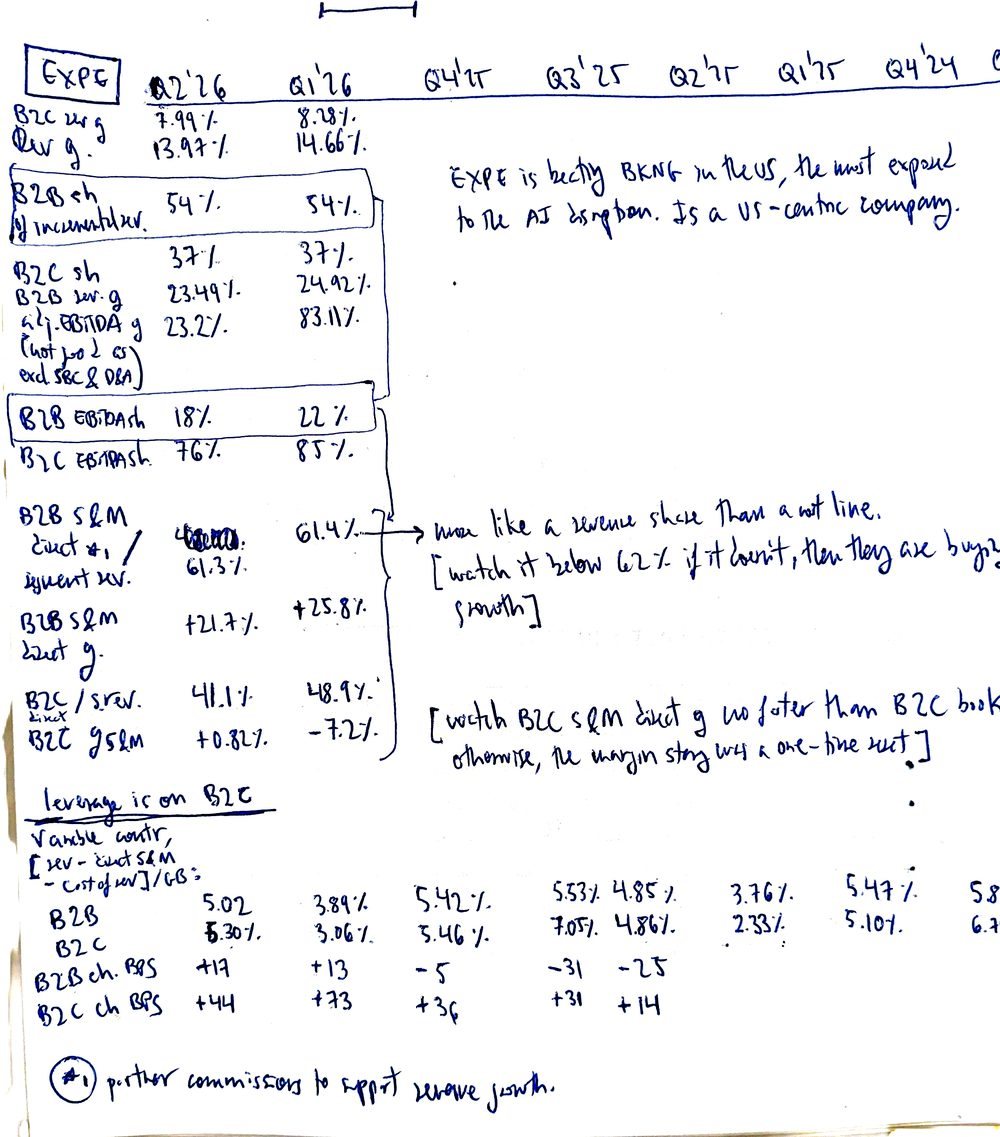
- B2C direct marketing expenses growing faster than B2C bookings
- B2B direct marketing expenses above 62% of segment revenue
- Consolidated growth net of the currency contribution, with inorganic growth discounted
The note
i filing · ii management · iii third party · H my calculation
Growth: less than it first seemed
I started by observing impressive growth in consolidated revenue since Q1’25, from 3.43% to 14.66%. It turned out to be less outstanding: over the last three quarters, year-on-year growth has been around 10% in constant currency. So growth has really plateaued since Q3’25, with perhaps a small uptick since then, but not the second-derivative acceleration it seems at first. In addition, taking gross bookings growth as a leading indicator, acceleration in the segment driving growth, B2B, peaked in Q3’25.
| Consolidated revenue, YoY growth | Q1’25 | Q2’25 | Q3’25 | Q4’25 | Q1’26 | Q2’26 |
|---|---|---|---|---|---|---|
| Reported | 3.43% | 6.41% | 8.67% | 11.4% | 14.66% | 13.97% |
Where the growth comes from
What stands out is management’s ability to control operating expense growth every quarter, generally well below revenue growth, and concentrated in the B2C segment, as I found next.
Looking for where the revenue was coming from, I found a business model in transition, from B2C-centric to B2B-focused. B2B’s compound annual growth over the last four years is above 28%, against 5.04% for B2C. Still, B2C generates 62% of revenue today and B2B 35%: ten points have moved between the two over the last three years. H
| Segment | Share of revenue | Four-year CAGR |
|---|---|---|
| B2C | 62% | 5.04% |
| B2B | 35% | above 28% |
Variable contribution: where the leverage came from
More disappointment came from the variable contribution metric. In most quarters, the operating leverage came from B2C, not from the fast-growing B2B: 54% of the incremental revenue growth came from B2B, but only 20% of the incremental adjusted EBITDA growth. H
Why? B2B direct sales and marketing expenses grew almost as fast as revenue. It is a sticky cost, acting more like a revenue share than a cost. At 61.5% of B2B revenue today, it should not pass the 62% mark; otherwise they are just buying growth.
So the operating leverage came almost entirely from B2C:
| B2C, YoY growth | Q2’26 | Q1’26 |
|---|---|---|
| Revenue | 8% | 8.28% |
| Direct marketing expenses | 0.82% | −7.2% |
Going forward, the watch is whether B2C direct marketing expenses grow no faster than B2C bookings. Otherwise, the margin story is a thing of the past.
The stance
As an appendix to my Booking analysis: Expedia is no better than Booking. Once you control for the dollar’s weakening over the last three quarters, its growth is no better than Booking’s. And if growth is no better, and each company’s forward guidance has in fact converged, you should pay more for the company with greater margins: Booking. The market currently gives the two roughly the same valuation, so I see more potential, and margin of safety, in Booking.
My action: Expedia stays on the watchlist, with no upcoming trigger to go long or short. Before changing the stance and deciding on a trade, I watch for changes in B2C direct marketing growth against B2C bookings growth, the 62% threshold for B2B direct marketing expenses as a share of segment revenue, and the currency contribution to consolidated revenue growth, discounting inorganic growth appropriately.
Position on the day of publication: none in Expedia, which is on my watchlist. I hold Booking Holdings, which this note compares favorably. I don’t trade against a published view in the 72 hours after publishing it, except to carry out a pre-stated exit or risk limit. Not investment advice.